Saturday, April 11, 2020

Prayer During the Corongavirus (Covid19) Pandemic

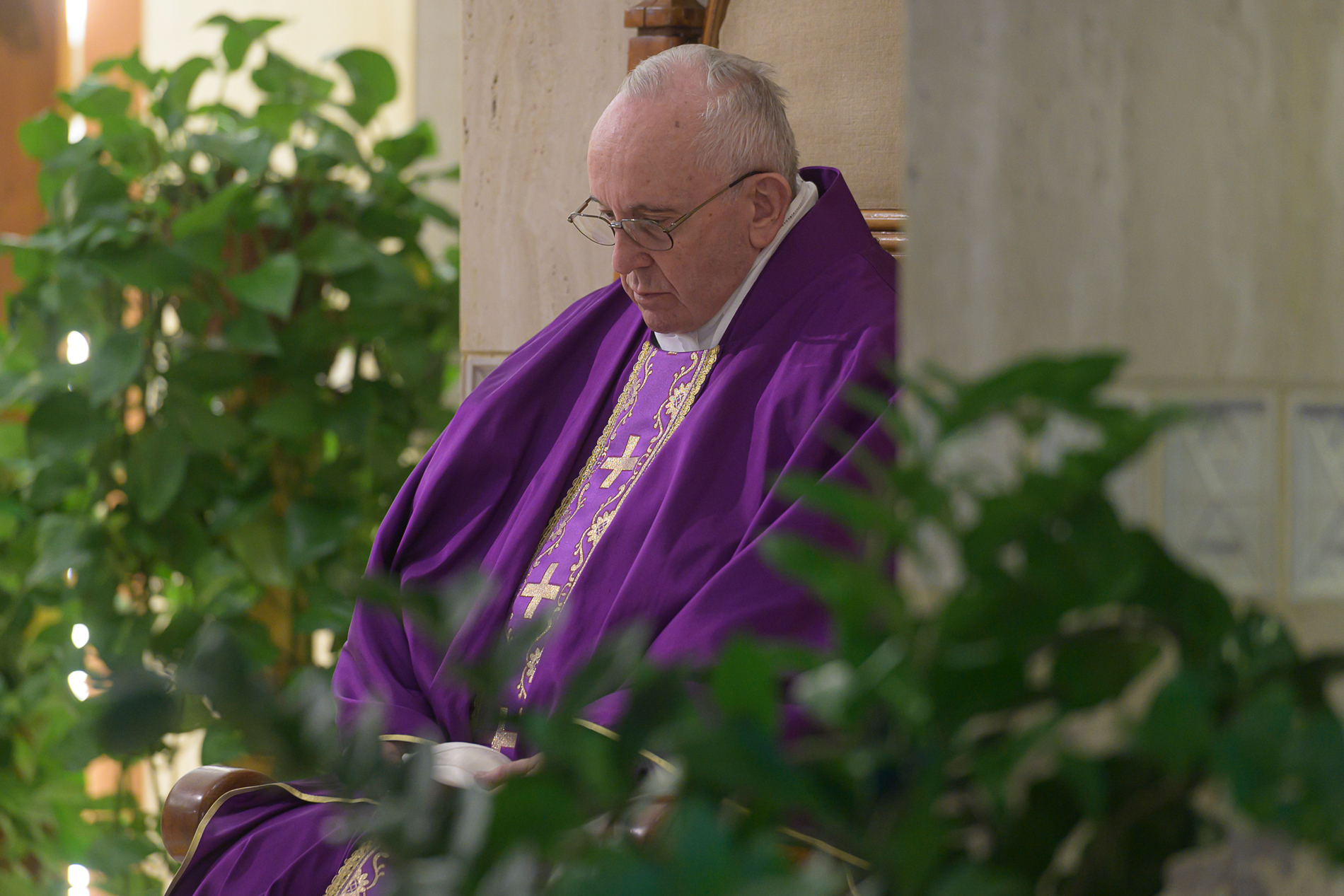
Read: Pope Francis's prayer to Mary during coronavirus pandemic ...


As usual, when something like a pandemic strikes, many non-believers will scornfully bash anyone who advocates prayer. They are so petty that even if a politician offers thoughts and prayers, they become upset and feel the need to voice their displeasure with this simple gesture.

I would like to talk a little about the purpose and effectiveness of prayer, and whether or not we should prayer in a time like this, i.e. during the Coronavirus (Covid19) pandemic.

In our modern world, we often have a sort of default materialistic attitude, even among believers. We view things through the lens of our temporal world. For example, when we think of prayer, we may think of gaining material possessions, or doing well on a test, or ending a pandemic. We see those types of things as our highest goals. I think part of this is due to the influence of our secular world on our thinking. Saints advise us that sin originates from three places: the world, the flesh, and the Devil. We are to be in the world but not of the world. Some go as far as to say we are to hate the world. This does not mean hating our neighbor or God, but rather putting the things of the world in its proper place which is well below God's proper place.

So the first thing to understand when it comes to prayer is the purpose of prayer, and more broadly our purpose in life. As a Christian people, we are not secular materialists. Rather, we are spiritual beings and our greatest good comes from having closer communion with God. It is part of our nature. God created us and as St. Augustine tells us, our hearts are restless until they rest in God.

Therefore, we must first get over the idea that the purpose of prayer is to achieve material or temporal success. I heard an excellent homily on the Sensus Fidelium Youtube channel where he discusses how to obtain anything through prayer. Much of what I will be saying in this blog post is inspired from this homily. You can find the video here.

In the talk, he says there are 3 conditions necessary for a prayer to be answered:

  1. Humility
  2. Confidence
  3. Perseverance
Humility, which is the opposite of pride, is probably the most important, and possibly rarest, virtue. It seems, for example, that those who bash prayer and its effectiveness are full of pride. Even if God were to grant their prayer, they would either not attribute it to God or they would just see him as a sort of cosmic slot machine. Put your coin in and you get a big payout. Repeat.

That's also how they deride believers. They mock God, just like some of the people at the foot of the cross. "Save yourself if you're really the son of God!" "Where's God now!" They demand that God obey their demands, and when he doesn't they act indignant, as if they were owed something from the Creator of the Universe. Obviously with such an attitude of entitlement and lack of humility, prayer will rarely be answered.

The second condition for effective prayer is confidence. We must believe that God can and will provide what we need in life, that he loves us and is there for us. St. Terese of Lisieux wanted always to be like a child in the eyes of God. She said as a child we believe our father can do anything. He will always be there for us and will never let us down. She said that's how we must be with God now as adults. Jesus Christ himself told us that unless we are like little children, we cannot enter the Kingdom of God.

The confidence of a child is what we must have in order for our prayers to be answered. We must trust that God loves us and does everything for our good. Sometimes a situation may seem hopeless, but with the trust of a child, we never lose hope. God will bring good from any evil if we allow him and fervently prayer for him to do so.

The third condition for prayer to be answered is perseverance. This is closely related to confidence. The example given in the video I linked is that found in a parable given by Jesus in which a man continually asks for bread from another man who is at first reluctant to provide it since he is already in bed and the door is locked. But the man who wants bread persists, and simply out of annoyance, the man in the house provides him bread. Jesus asks how much more will our Heavenly Father provide for our needs since he loves us more than we love ourselves?

Back to prayer and this pandemic. If we have all three of these characteristics when praying, we will find great advancement in the spiritual life. We will be given everything we could possibly ever need and become holier and closer to God. This is what we truly need. But God operates in other ways as well. He does provide miracles as has been shown countless times throughout history. He can help us with our material as well as spiritual needs. But we cannot approach him with an attitude of testing him or of pride. This attitude will only move us further from God, not closer.

I once heard a very interesting concept which was that if we were all holy saints on Earth, none of the earthly, material issues would be of any concern to us. We would offer up our sufferings to join more fully in the suffering of Christ who redeemed the world. We would not fear death and we would live joyfully. This is what God wants for us. We cannot reject the spiritual completely and just make materialistic demands on God. He would not provide that for us as it will only push us further away from him.

If you have anything to add, please do so in the comment section below. I really love hearing from you!

Friday, April 10, 2020

GOOD FRIDAY PRAYER: President Trump Blessings At The White House

Where can I attend a Catholic Good Friday Service this year during the Coronavirus (Covid19) Pandemic?

Editorial: Real 'Easter People' will stay home | National Catholic ...


Many people are wondering if they can attend Good Friday services or related Church services such as Holy Thursday Mass or the Mass on Easter Sunday in person? The answer is that almost everywhere these events are being cancelled, churches are closed, etc. There is one slight possibility to attend a service in person. Wait till the end for that.

In the United States for example, almost all churches are closed. Some non-Catholic churches have tried to hold services and many were in violation of rules surrounding social distancing. They were sometimes visited by police to have the services shut down.

In Canada, pretty much all Catholic churches are closed during this time.

Some governors of the United States, for example Greg Abbott of Texas,  have declared Church services to be "essential" along with grocery stores and doctors' offices. Despite this however, both archdiocese in Texas - Galveston-Houston, and the Archdiocese of San Antonio have cancelled all Catholic services throughout the state.

I am not familiar with any place that is having regular Catholic church services. Some places have been innovating though, for example having drive-in Masses and using innovative ways to give confession.

There is one [weird trick]  possible solution to attending Mass in person. Maybe more than one possibility, but here it is. If you ever watch a live stream of a Mass or other church service, you may notice there is sometimes another person or people there. For example, I watched Fr. Mike Schmitz last night for Holy Thursday Mass and there were two other people there for the readings. They even received communion.

Even our live stream we have here in St. John's, Newfoundland, Canada, there are individuals who read or sing, etc. for the priest. If you know a priest personally, you may be able to participate in this way.

I have heard some other "rumours" of people attending sort of clandestine services. Taylor Marshall mentioned on his podcast that he had attended a Mass in a barn. He did not disclose any specific detail. He said they took extra precautions and people were made to sit at least 6 feet apart.

A friend of mine mentioned attending a Mass service, but again indicated it wasn't publicized and was a private event.

There are some interesting possibilities there that some people have the ability to explore. But for the most part, unfortunately, Mass and other Catholic church services are cancelled around the world.

Ideas to Celebrate Good Friday During the Coronavirus (Covid19)

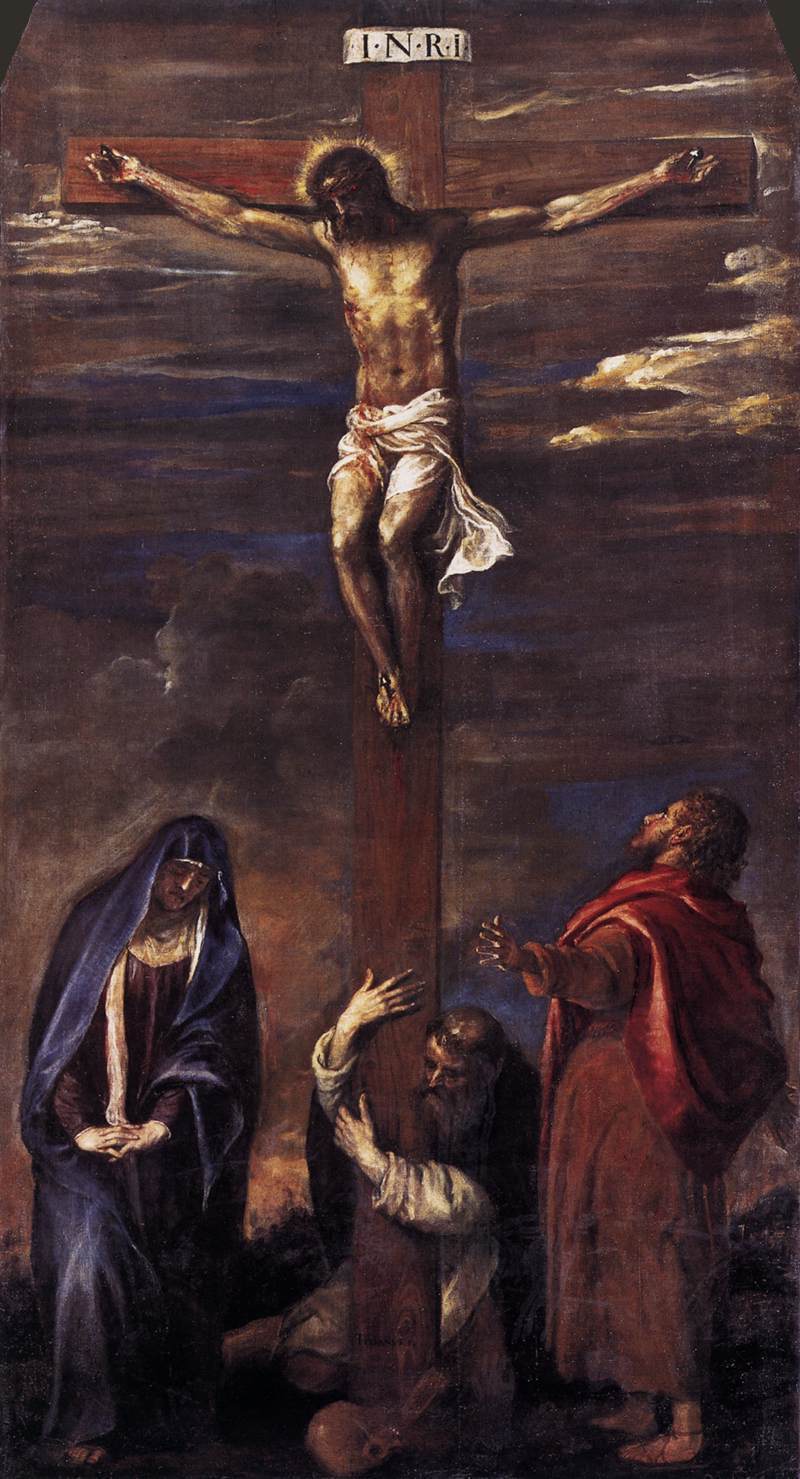
Crucifixion (Titian) - Wikipedia


We are in an unusual time for the Church. Most of us as faithful Catholics cannot partake in the sacraments during this most holy time because of the Covid19 pandemic. In fact, the most holy days of the Church are currently occurring. Jesus Christ gave himself fully on the cross, a sacrifice in atonement for our sins. From this sacrifice, all graces of God flow, just as the blood of Christ flowed on the Good Friday where he was crucified.

For Christians, and specifically Catholics, this is the most holy time of the year. Jesus Christ dies and will rise again in 3 days. It is the central mystery of the entire Christian faith. Sadly, we cannot celebrate these holy days as we normally would: gathered together with other faithful during the Good Friday service as well as other events within the Church.

So what can we do in a time like this? How can we join ourselves more closely with Christ's suffering, death, and ultimate resurrection? I can share a few ideas. I highly encourage anyone who may have other ideas to share them in the comments section.

Good Friday Service
Good Friday Service (which is not a Mass since the Holy Eucharist is not consecrated) traditionally occurs at 3:00pm which is the time that Jesus gave up his spirit on the cross. If you are able, I would strongly recommend tuning in to a live broadcast of a Good Friday service wherever you are in the world. There are many available online. One that I have been watching has been Fr. Mike Schmitz who broadcasts various services from his personal chapel. I get a lot out of his powerful talks.

Here is a link to his channel (Ascension Presents). There you can find upcoming programming. https://www.youtube.com/channel/UCVdGX3N-WIJ5nUvklBTNhAw

Many local churches are also broadcasting at this time. In my own area, there are probably a half dozen churches doing such broadcasts, and this is not to mention broadcasts from priests' private chapels.

Stations of the Cross
Another Traditional observance by Catholics is the Stations of the Cross during Good Friday. In it we remember the events that happened during the Trial of Jesus, his passion and finally his execution on the Cross. This can either be done with one's family, alone, or along with others on a live broadcast on the Internet. I am not sure of any particular service such as this available on Youtube or other platform at the moment, but I will definitely be looking for one tomorrow.

Other Observances
Of course, other traditional Catholic spiritual practices can be done during this time such as reciting the Rosary, praying the Chaplet of Divine Mercy. Don't forget to practice silent prayer. Also, Good Friday is one of the most important fasting days of the Church's calendar. All Fridays are days of fasting and abstinence from meat, but in particular this is the case for Good Friday. Try to do something extra this year, particular in this climate of fear and uncertainty and inability to access the sacraments. At this moment, our prayers and fasting are more important than ever.

I wish you all a very holy Good Friday.

Please post your comments or ideas below. I look forward to hearing from you.

Thursday, April 09, 2020

Baptism During Coronavirus (Covid19)

Sacrament of Baptism | Catholic pictures, Catholic images, Catholic


Should people be baptized during this pandemic? What considerations should be made when considering the appropriateness of this? What other areas must be explored?

Baptism is the entry into the Body of Christ, the Church. It removes the stain of original sin as well as any personal sin and fills a person with God's Grace. It is necessary for salvation as Jesus Christ himself proclaims in many parts of the Bible. A person cannot receive any other sacrament from the Church unless and until they are baptized into the Church.

Since baptism is necessary for salvation, it is of utmost important to provide baptism to anyone who so chooses or to an infant belonging to Catholic parents. But during a pandemic, other considerations must be made.

My input into this situation are just my opinion and do not reflect the teaching of the Catholic Church. If you disagree with what I am saying or would like to point out anything, please feel free to do so in the comments section below.

I believe in the case of an infant being baptized, discretion must be used as to whether to proceed during the Coronavirus. I can't say a blanket statement of whether a baptism should or shouldn't go ahead at this time. If a baby is in danger of death or is in ill-health, a baptism, in my opinion, would be highly recommended. It would be irresponsible to forgo it in this circumstance.

However, if a baby is perfectly healthy and has no major issues, it may be best to wait to have the child baptized when everything is back to normal. But I think this is a prudential judgment. Again, depending on the parents, some may feel it would be good to have a child baptized as soon as possible by a priest even in the current situation. Of course, this would require a very small ceremony, and the priest may take certain precautions such as not touching the child.

So again, it's a matter of prudential judgment.

What about in the case of a child who is in danger of death? According to the Church, baptism can be administered by anyone in cases of emergency. They must simply have the requisite intention (i.e. intend what the Church does vis-a-vis baptism) and use the correct Trinitarian formula. If these conditions are met, the baptism is valid.

The coronavirus pandemic would not satisfy the condition of a child being in danger of death and thus allow emergency baptisms to be performed. That is because although there is a pandemic in general, a particular child may not be at risk of death whatsoever. The lack of availability of the sacrament of baptism throughout a particular diocese likewise does not satisfy the conditions for performing an emergency baptism.

The same rules would apply in the case of an adult seeking baptism, otherwise known as catechumen. Catechumen can normally foresee the date of their baptism well in advance. If something like this pandemic breaks out and sacraments by and large are cancelled, they will probably have to make new arrangements to be baptized at a later time. Again, as long as they are not in danger of death, they may want to hold off on being baptized.

As mentioned in previous blogs, although certainly not a prerequisite, if a person were to opt to partake in a sacrament such as baptism, confirmation, or marriage during a pandemic, it is highly likely there would be very few people in attendance. In some areas it would be illegal. Again, although this is not an impediment to the validity or licitness of the sacrament, it is still a consideration as these sacraments as meant to be celebrated by the community and not in private.

What are your thoughts? Sorry I did not have the definitive answer, but I think it's up to each person and family to decide in their own individual circumstances with the help of God to whom they should pray when discerning. I would tell people not to become discouraged or disobedient to proper authority.

Please provide your thoughts in the comment section below. Until next time!